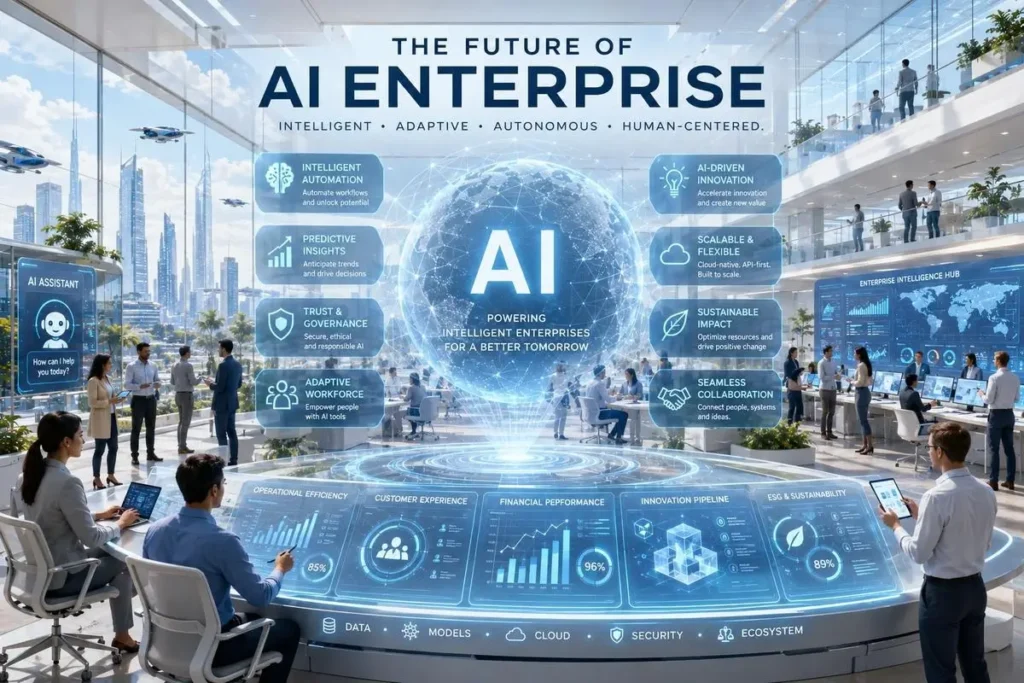

Most companies are adding AI to the business. The more important question for 2026 is whether they are redesigning the business around what AI makes possible.
A company can deploy copilots, chatbots and AI assistants across dozens of departments and still operate essentially the same way it did before. Employees may continue copying information between systems, waiting for approvals, searching through disconnected knowledge bases and manually coordinating routine decisions.
An AI native enterprise takes a different approach. Instead of treating AI as another software layer, it redesigns selected workflows, decisions and operating processes around intelligent systems while keeping appropriate human control.
The difference is strategic. AI adoption asks, “Where can we add AI?” An AI native strategy asks, “If AI were available from the beginning, how would we design this process?”
The goal is not to automate everything. Build around AI where it can remove friction, improve decisions and increase organizational capacity—then preserve human judgment where consequences are significant.
What Is an AI Native Enterprise?
An AI native enterprise is an organization that designs its products, workflows, decision processes and operating model with AI as a core capability rather than treating it as an isolated productivity tool.
That does not mean every employee needs an AI agent or every process needs automation. It means AI becomes part of the architecture through which work gets done.
A traditional workflow might look like:
Request → Employee → System → Review → Decision → Action
An AI native workflow could become:
Request → AI Interpretation → Context Retrieval → Recommendation or Action → Human Control → System Update
The important change is not the presence of AI. It is the redesign of the work around AI’s capabilities.
AI Adoption vs. Becoming AI Native
| Area | AI Adoption | AI Native Approach |
|---|---|---|
| Purpose | Add AI to existing work | Redesign work around AI capabilities |
| Workflow | Mostly unchanged | Re-engineered where valuable |
| Data | Often fragmented | Designed for usable context and access |
| AI role | Assistant or productivity tool | Embedded operational capability |
| Measurement | Usage and activity | Business outcomes |
This distinction matters because buying more AI software does not automatically create an AI native organization. The underlying process, data and ownership model still determine whether the technology produces value.
Why AI Native Enterprises Matter in 2026
Enterprise AI is moving from experimentation toward operational deployment. As more organizations gain access to similar foundation models, the model itself becomes less likely to be the only source of differentiation.
The harder advantage can come from how an organization combines AI with proprietary information, internal processes, customer knowledge and technology infrastructure.
The strategic shift:
The question is moving from “Which AI tool should we buy?” to “Which business processes should be fundamentally redesigned because AI changes the economics of the work?”
Organizations already developing an enterprise AI operations capability have an important foundation for managing these systems after deployment.
What Changes Inside an AI Native Business?
Becoming AI native affects more than technology. It can change how teams handle information, how decisions move through the organization and how employees spend their time.
| Business Layer | Traditional Model | AI Native Model |
|---|---|---|
| Knowledge | Employees search manually | Context is retrieved when needed |
| Customer service | Manual triage and response | AI classifies, assists and routes cases |
| Operations | Periodic reporting | Continuous analysis and recommendations |
| Decision-making | Static reports | Context-aware decision support |
| Software delivery | Manual development cycles | AI-assisted development and testing |
The objective is not to remove people from these processes. It is to move employees toward work where judgment, accountability, creativity and relationship management create greater value.

Start With Workflows, Not AI Tools
One of the biggest mistakes companies make is selecting an AI product before understanding the process it is supposed to improve.
Start by mapping how work actually moves through the organization. Look for repeated data entry, unnecessary approvals, manual classification, slow information retrieval and handoffs between teams.
High-value workflow signals
High volume + repetitive work + accessible data + measurable outcome + manageable risk = strong candidate for AI redesign.
Companies exploring AI workflow automation for enterprises can use this approach to identify where automation and AI reasoning should work together rather than separately.
Build the Data Foundation First
AI cannot make an organization intelligent if important information remains trapped in disconnected systems.
AI native businesses need reliable access to the information required for each workflow. That may include CRM records, ERP data, internal documents, customer history, operational metrics and approved knowledge sources.
But access must be controlled. The objective is not to give every AI system access to everything. It is to provide the right context to the right system at the right time.
More data is not automatically better. Clean, relevant, current and permission-controlled information is far more valuable than an uncontrolled collection of enterprise data.
The NIST AI Risk Management Framework provides organizations with a structured way to think about AI risks and trustworthy AI practices across the lifecycle.
Where Human Judgment Still Matters
An AI native enterprise is not a human-free enterprise. In fact, strong AI operating models make the boundaries between machine action and human accountability clearer.
| AI Can Typically | Human Should Control |
|---|---|
| Classify information | High-impact approvals |
| Summarize records | Legal or regulatory judgments |
| Recommend next actions | Major financial decisions |
| Detect anomalies | Critical security responses |
| Prepare routine outputs | Decisions with significant customer consequences |
This human-control layer becomes especially important as organizations introduce more autonomous agents. Permissions, monitoring, escalation paths and auditability should be designed before systems are allowed to perform consequential actions.
How to Measure an AI Native Transformation
AI usage is an activity metric. It is not proof of transformation.
Executives should measure whether redesigned processes actually improve the economics or quality of the business.
| Metric | What It Reveals |
|---|---|
| Cycle time | Whether work moves faster |
| Cost per transaction | Whether operating efficiency improves |
| Error and rework rate | Whether output quality improves |
| Employee capacity | How much manual effort is recovered |
| Revenue or conversion | Whether AI contributes commercially |
| Customer resolution time | Whether service improves |
Establish the baseline before deploying the redesigned workflow. Otherwise, organizations may struggle to distinguish genuine business improvement from simple increases in AI activity.
Common AI Native Enterprise Mistakes
1. Treating AI as a Software Purchase
Buying another AI application without changing the underlying process often produces another disconnected tool.
2. Automating a Broken Workflow
If a process contains unnecessary steps, AI may simply make the inefficient process run faster.
3. Ignoring Governance
AI systems need clear ownership, permissions, monitoring and escalation procedures—especially when they interact with sensitive enterprise information.
4. Scaling Before Proving Value
A successful demonstration is not the same as production readiness. Pilot, measure, improve and then expand.
5. Measuring AI Activity Instead of Business Results
Prompt volume and model usage can rise while business performance remains unchanged. The scoreboard should remain focused on outcomes.
A Practical Roadmap to Become AI Native
Map → Prioritize → Prepare → Redesign → Govern → Measure → Scale
The Future of AI Native Enterprises
The next phase of enterprise AI will likely involve a mixture of foundation models, specialized models, AI agents, business data, workflow automation and governance systems.
The strongest companies will not necessarily be those with the largest number of AI tools. They will be the ones that understand where AI changes the economics of work and then redesign those processes deliberately.
That creates a more durable advantage than simply adding an AI assistant to an existing workflow.
Final Thoughts
Becoming an AI native enterprise is not about replacing every employee or forcing AI into every department. It is about recognizing where intelligent systems can fundamentally improve how work moves through the organization.
The practical path is straightforward: identify valuable workflows, strengthen the data foundation, redesign the process, establish human controls and measure the business outcome.
The winners in enterprise AI will not simply use AI more. They will design better businesses around it.
Frequently Asked Questions
What is an AI native enterprise?
An AI native enterprise designs selected workflows, operations and decision processes around AI as a core capability rather than treating AI as a separate productivity tool.
What is the difference between AI adoption and becoming AI native?
AI adoption adds artificial intelligence to existing processes. An AI native approach redesigns processes when AI can fundamentally improve how information, decisions and work move through the organization.
Does becoming AI native mean replacing employees?
No. The strongest approach uses AI for repetitive analysis, coordination and routine work while keeping people responsible for judgment, accountability and high-impact decisions.
How should an enterprise start its AI native transformation?
Begin with a measurable workflow where repetitive work is high, useful data is available and risk can be controlled. Pilot the redesigned process before expanding it across the organization.
How do companies measure AI native transformation?
Track business outcomes such as cycle time, cost, quality, employee capacity, customer results, revenue and risk rather than relying only on AI usage metrics.